

"How are you?"
...the answer is quite likely not "fine."

You’ve heard the quote: “That which doesn’t kill you makes you stronger. “
The original quote was taken from Nietzsche’s Twilight of the Idols, and read: “Out of life’s school of war, what does not destroy me, makes me stronger.” I admit to not having read Twilight of the Idols, so I’ll address this quote in its common modern-day usage. People throw around this phrase as one of empowerment. But to me, it’s not empowering at all. It’s a hopeless helpless statement. As if we have to go to the edge in order to grow. Sure, sometimes, that’s how it works, this beautiful and heartbreaking thing called life. The edge is a very real and sometimes dark place. And coming back from it, whether physically or emotionally, can be vastly powerful. But right now, I’d like to depart from physical pain, and focus on emotional pain. On the emotional “school of war.” It doesn’t have to be a war. We can find freedom in emotional pain. Because emotions are our choice.
It’s all about awareness and re-training your mind.
Let’s start here: let’s try to stop mincing the physical with the emotional. I think it confuses us and sends negative, disempowering messages to our entire being when we do. Your back isn’t “killing” you. It might be in pain. But it’s not “killing” you unless you have a very real disease, and that’s a different subject altogether. Your husband didn’t “make” (physical) you mad (emotional). Your sister didn’t “make” you cry. Your mother-in-law didn’t “make” you feel guilty. Again, cruel actions are real, and emotional pain is real too, but it’s how we engage someone’s actions—how we relate with them, that determines our emotional state. The responsibility is ours. No one else’s.
I invite you to re-read the above quote and ask yourself, again in the realm of emotions: Can a heart really “break?” Does pain really “kill?” Can anybody really “make” a person feel something emotionally?
In the moment someone throws us a verbal barb, we have a choice. Sometimes that barb is so unbelievably cruel that we feel it has lodged in our emotional world without our permission.
But that’s actually not possible. We have, sometimes at the speed of light, chosen to give it the power to hurt us. And that’s the moment at which I’d like to see us pause. Become aware of what’s going on. Aware of our choices. What’s at stake. What’s worth our anger, our tears, our hatred, our guilt. We think there’s a bridge there that we have to cross. There isn’t and we don’t. We choose our emotions, good, bad, ugly. And so often we choose to be emotional victims. But I don’t believe there really is such a thing as an emotional victim.
A victim is someone who suffers incontrollable consequence because of someone or something else. But emotionally, that’s not possible. Contrary to how society spins it, in reality, there is no such thing as an emotional victim. Imagine that you’ve prepared a lovely meal that took you hours and into which you put all your culinary expertise. And your guest, without even tasting the food, says, Pass the salt. Now that Pass the salt could be taken as an insult. You aren’t a sufficient cook. You’ve been slighted, underestimated, judged. And you feel shame. Or anger. Or hurt. And there you are: at the bridge. You do not have to cross it. You can simply pass the salt.
I’m not saying to suppress your emotions or hold your tongue. Of course there are times to let those words come careening at you over the bridge…but still, you are in control. You can still take your pause no matter how fast they are coming at you, and decide to invite them in—to choose to attach meaning to them and thereby react emotionally, whether internally or externally. But remember, your emotions are your choice. You have options. No one can choose them for you.
AND, emotional hurt doesn’t need to look like a tantrum. You can sometimes just say, “Ouch.” And what happens, in that case? In my experience, the words go running back over the bridge, or jump in the river and float away. Let them run around somewhere else other than in your being. They can just be words even if they are cruel ones. You do not have to take them personally. Even when they’re meant personally.
I fought this awareness for a long time. I wanted to believe that someone could emotionally hurt me.
I was used to walking around with my finger out, placing blame, rather than make the daunting decision to take responsibility for my emotions. Emotional suffering had become my normal. I chose to play victim all too often. And I was sick of it.
I realized, quite suddenly in a therapist’s office, that I was choosing to emotionally suffer at the flung words and actions of people. I was choosing to let things outside my control determine my emotional state. I was choosing to suffer. So I started changing the way I related with emotionally painful moments. When I met with hard moments, rather than play victim, I’d ask myself powerful questions. Did I want those tears? Did I want that anger? Sometimes the answer was, yes. But if so, I wanted to powerfully choose that yes. I wanted to be in charge of how I translated painful emotional experiences. And statements like “That which doesn’t kill you makes you stronger” didn’t help one bit. I think a far better statement came from Eleanor Roosevelt, “No one can make you feel inferior without your consent.” I was in charge of my emotions. Period.
For about six years, starting in 2010, I went around the country talking about this at conventions, universities, author series, YMCAs, etc. because I wrote a memoir called This Is Not The Story You Think It Is: A Season of Unlikely Happiness. It was published in nine countries, so I did interviews all over the world, and I came to see that there are many many people out there who don’t want to receive this message. It means they’d have to get out of blame, out of victor/victim thinking…and into personal responsibility. They’d have to tell themselves a new story about where their power really lies. They resist, complain, deny. And guess what? They get to be right. See, the world stinks. See, I’ll never get that job, or that relationship, or that break. That is bondage.
Now, in 2026, I’ve been going around the country with a new book that builds on my memoir’s themes. It’s called The Wild Why: Stories and Teachings to Uncover Your Wonder.
While my memoir’s entry point was a marital crisis, this book’s entry point has to do with what I feel is a global crisis in the realm of self-expression. True self-expression. In other words, people are in a story that they don’t have anything authentic to say, not that matters anyway, and they gag order themselves and walk around saying that they’re fine when their hearts are bashed and bloodied. Do you owe everyone your truth? No. But you do need to find someone safe that you can share your truth with. To honestly share your answer to “How are you?”
At the end of the chapter The Tiger in the Room, I offer this seemingly simple prompt. After a six-week tour, and recently another four-week tour for this book, I’ve heard from a lot of readers and this is the chapter that seems to most resonate across the country. Because in this chapter, I’m modeling the need to make a serious effort to share your story with a friend. To take the time, and I mean not just lunch. Or a text. Or even a phone call. But to carve out at least two hours to share your answer to “How are you?” A whole afternoon is better. Maybe a weekend. And then to do the same for your friend. This isn’t a silly frilly idea for people with too much time on their hands. This is life force.
And it’s fueled by the need to return to our wonder. Without wonder, we don’t have empathy. And without empathy…we don’t have a civilization.
We need to find safe places to speak our truth. And when we do, the barbs that come from others get diluted because we are taking charge of who we are and how we express ourselves. Not letting ourselves be defined by supposed to be or should or anything outside of our own control. Emotional freedom is possible. And it’s really not that hard…
Here’s the prompt:
Find a friend with whom you feel safe in the realm of self-expression. Pick a topic that you need to parse but that scares you. Maybe start with the question of “How are you?” Ask your trusted friend if they would be willing to sit with you for a stretch of time and look at it from many angles, not necessarily looking for answers. If you find answers, that’s a bonus. This is an opportunity to roll around in wonder with someone you trust. See what you find.
And then, after you’ve shared with your heart language with your friend…privately, write your answer, for your eyes only. You might add things privately that you wouldn’t share publicly, even with a dear friend. Be your own safe friend. Care about yourself. Be honest with yourself. And be kind. Because I want you to step out of the bondage of gag-ordering yourself and telling half-truths or just flat out lies. I want you to step into your wonder and the truth of who you are in this moment of your life.
I’m not interested in bondage. I’m interested in freedom. Are you?
For more information about my Haven Writing Retreats in Montana, and to set up an introductory call with me, go here.
You do not have to be a writer to come to Haven. Just a word-wanderer, who is serious about finding your voice and learning your craft, no matter where you’d like to see it land. Ultimately, it’s about building the bridge of authentic self-expression to YOU! From there...you can go anywhere...
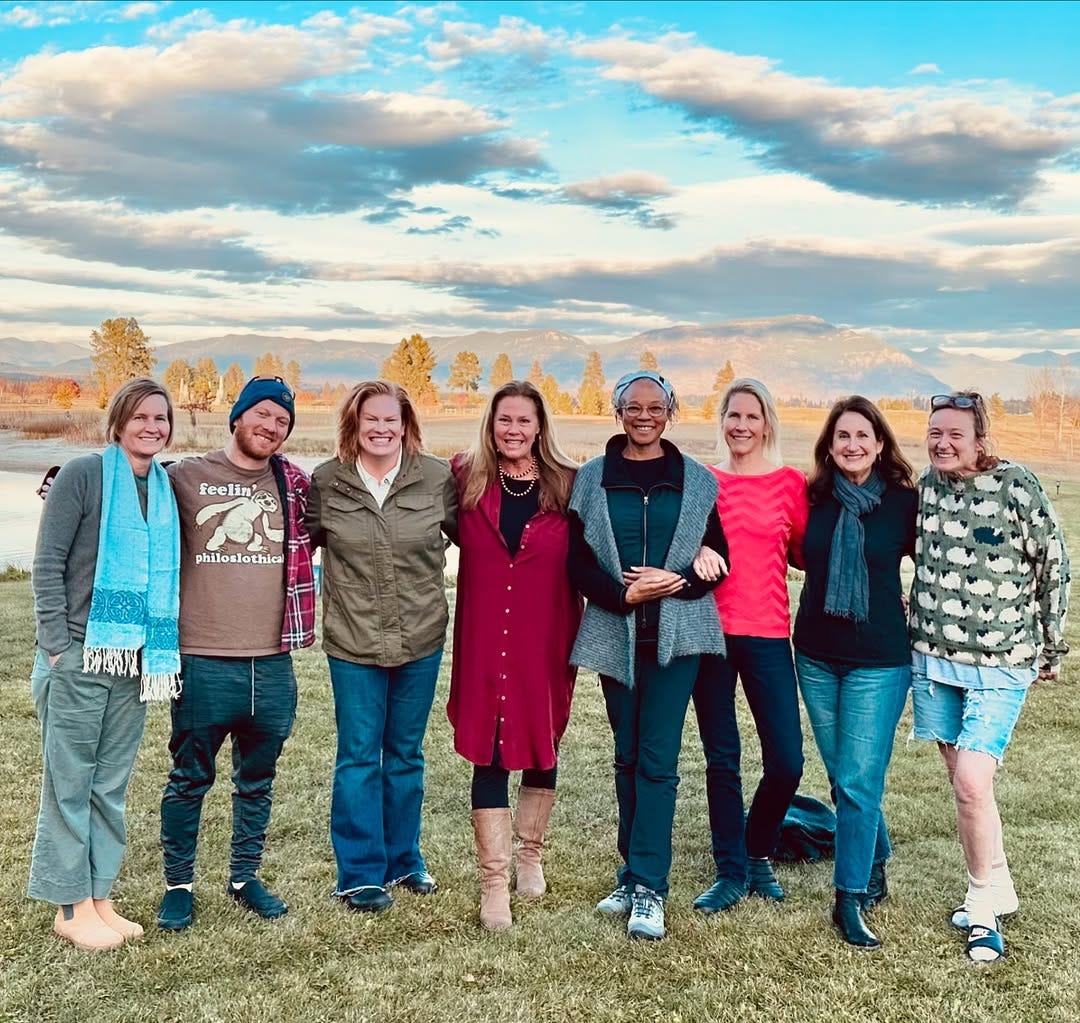
Now Booking the 2026 Haven Retreats
March 25 – 29, 2026 – Full
June 3 – 7, 2026 – Now Booking
June 24 – 28, 2026 – Now Booking
September 16 – 20, 2026 – Now Booking
September 23 – 27, 2026 –Now Booking
October 14 – 18, 2026 – Now Booking
Thank you for your beautiful article. I love your thinking and writing.
Such timely words. But isn’t that how it usually goes? Appreciating your words, your wisdom, and my time at Haven. 10 weeks to my launch date - Haven gave me confidence to make it to this threshold. Thank you Laura.