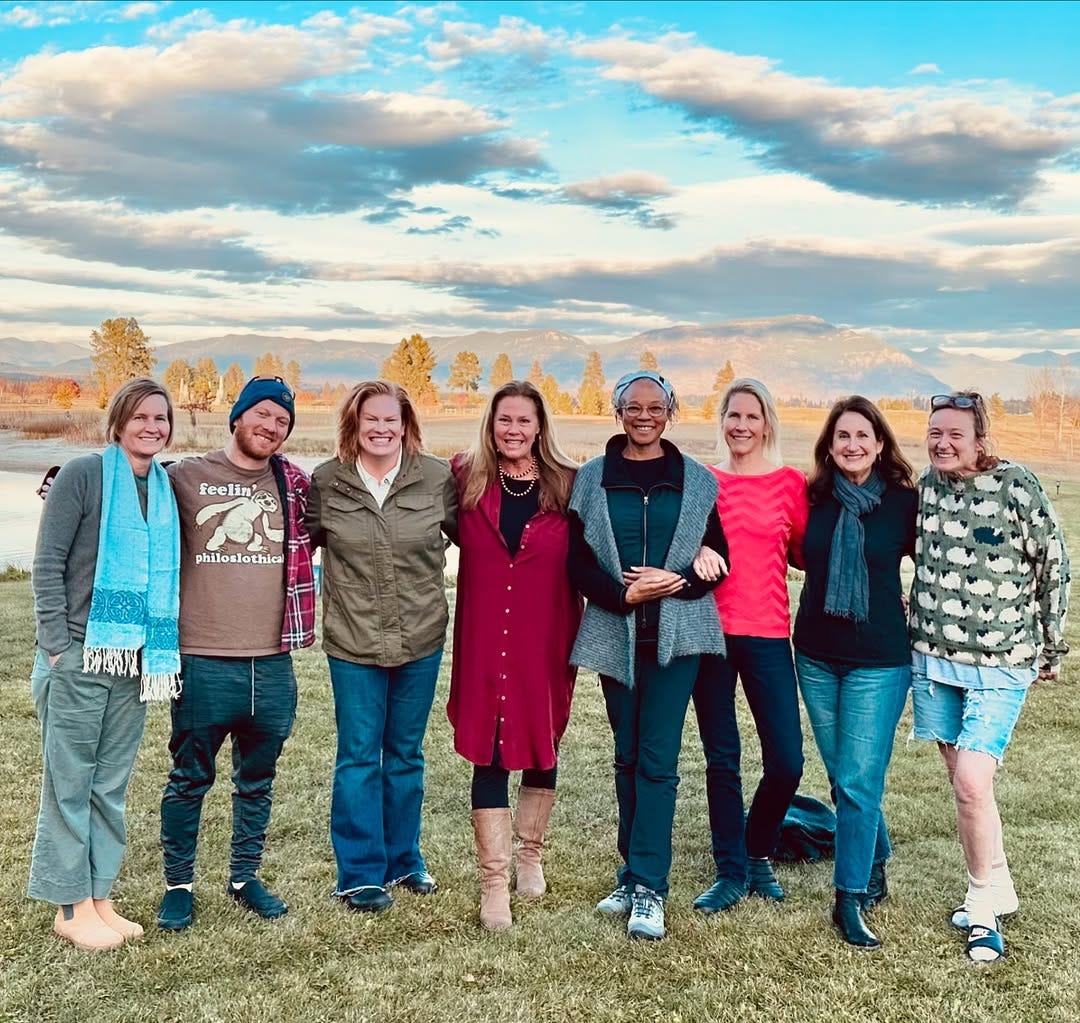
The Common Thread
How to find what you need to say

Note: I wrote this for writers, but it’s for all of us in the way of finding our true self-expression
When I speak to a potential Haven Writing Retreat client, on our one-hour informational phone call, after I’ve set up the guidelines of the call and assured them that everything they share with me is confidential, I often begin the conversation with this probing question/call to action:
“If there is a central question that burns in you…that you want to write into and even answer…what might it be?”
I give them a moment to think about it. Their answer helps me to understand how my program, and I, could support them and if it’s a good match.
They usually pause. I think it’s likely because people don’t get asked good questions often enough in safe, confidential settings. Plus, we’re basically strangers—yes, meeting for a strong purpose, but still…people are often scared. If they’re still silent, I try to help them by adding:
“There’s no right or wrong answer. But ask yourself: What burns in me? What keeps me up at night? What do I promise I won’t bring up at the family reunion but seem to anyway? Your answer will help you tune into what’s at the essence of what you have to say and consequently, what you want to write about. And it will help me know how to present Haven to you, because while each attendee is doing the same retreat, each person is doing it a bit differently. I like to custom-make each person’s experience.”
If they are still drawing a blank, to help guide them, I’ll often get more specific in hopes of activating their imaginations and true longings. Without longing, I know I can’t help them. That’s, in fact, what I’m really listening for.
“Often it’s a question of identity: Who am I now? Or a question that has to do with belonging. I’ve been in so many roles. They’ve changed. What do I belong to now? What defines me as the human I am at this very moment in my life? Maybe you’re in a should I stay or should I go moment of your life and your question spawns from that? Maybe you’re in a new chapter and you wonder…what is my worth now? What is a question that burns in you?”
If they’re even still drawing a blank, I might say, “It’s okay. You don’t have to have an answer. But just having a question can beget the writing that needs to come out of you. As Rilke wrote: Love the questions themselves. Let’s move on and talk about your writing dreams and talk all things Haven.”
People like to be asked good questions, at least seekers do.
In thousands of these Haven intro calls since 2012 when I founded Haven, I’d say only five people have drawn a complete blank when I’ve asked that question. These are people driven by curiosity by nature. Most of them come up with something, some immediately. “Oh, I know exactly what my question is.” Others take a bit of cajoling. When I mention the question of who am I now?…that almost always elicits their response to my question. In fact, across the board, whether cajoled or not, that is the question people offer me in one way or another. Who am I now?
I think it’s because people have had meaning in their life that can drain out when things change like in empty nest, or retirement. Or grief. Heartache in general. Something major has happened that has them wanting to write. They’ve rounded the bend to a new time in their lives. And they’re disoriented, or they’ve lost their way almost entirely. Their ballast. Their purpose. Their purchase. Their currency. And writing feels like a way to find it again, only in a new way. That new way, that world of possibility, even if it is just an inkling, is likely what had them think about going on a writing retreat, find Haven, go to my website, contact me, arrange a time for the introductory call, and actually pick up the phone. Only to be asked this deep question. Every single one of those steps takes courage. Some people tell me that it took them years before they had the courage to reach out. I handle them as kindly, clearly, and gently as possible in honor of exactly that.
Then the retreat happens, and unless we’ve done some editorial work together prior to it, the writing officially begins. Perhaps they already consider themselves writers and are working on a project. Perhaps they’re brand new at it. Either way, the writing that we do at Haven is usually the most layered, craft-forward, illuminating education in finding what I call “heart language” they’ve experienced. It’s not a self-help retreat. But the writing exercises, coupled with the workshops, the community, the one-on-one consulting time with me, and the woods of Montana make for a holistic approach that goes deep fast, and is bound to stay with you long after the retreat…if you let it.
To that end, here’s the issue that many people have when they get home from Haven:
They arrive at Haven with expectations that we set up on the introductory call, coupled with what they bring on the retreat personally and usually privately. Over and over again, as they say their goodbyes, they look at me with those windows-to-the-soul wide-open eyes, and say, “This far exceeded my expectations. I could never have even known how to expect what I learned at Haven and how I feel right now.” Of course, it fills my heart. But how to keep it going.
Even though I speak to re-entry on the last night of the retreat—to go slowly and be care-full, too often, when people go back to their lives from a profound experience, they get reabsorbed into it in a way that stops their new flow, their new longing, and in Haven’s case, their hunger to write their hearts out. They quickly go back to their usual habits and distractions, managing responsibilities and life in general. And they abandon the pen that moved so fluidly and courageously in Montana. It’s why I offer post retreat consulting and editorial services. (To Haven alums or those who have been accepted into the program only, which is part of the investment. It’s not just one and done if you’d like more, and most people do.) But many people just don’t know how to make time for their writing when life is life-ing all around them at home. Life most often doesn’t behave like Haven wherein you have room to get to know yourself again and in such a new way, in the abundant woods of Montana. They leave changed, but then they can often stall out once they go home. And when I hear from a Haven alum who confesses that they just aren’t showing up for their writing, it upsets me. I don’t want the flow in the hose to get kinked.
So I spent some time hunting for, and implementing some answers. I started my online writing community Haven Nest (next enrollment to be announced). I started my advanced writing programs. I offer regular consultation and editing. But even signing up for these entities requires some gumption. And life can be a gumption-kill.
What if I returned to question-asking with these alums, as in our initial pre-retreat call re: their central burning question? What other question could I ask them that would inspire them to show up for their writing?
I am offering what I came up with to you here in hopes that it will help you think in a new way that is not about piece-mealing life, but rather, as a continuum.
It’s a question which helps people want to make time for their writing again, because that’s what it comes down to: you have to hunger for your writing. If you don’t hunger for it, you’ll prioritize ye olde time suckers. Bills. Groceries. Even if they’re not exactly pressing, we’ll make them pressing because what was originally a longing for our writing can quickly become something we fear. Feel ashamed of. Not show up for. We allow the inner critic to lord over us and keep us small, when not long ago, we felt Montana-expansive. And when we let fear run our lives, we create a continuous check list that we will never finish until our last breath.
I used to joke with my mother, who was a consummate check-list maker and checker-offer, “Are you going to write Die on your dying day, and then cross it off and go into the great beyond?” She’d smile but faintly because to her it likely sounded like a prudent way to go out. The final check. She basically brought that to fruition a few weeks ago. She did what she wanted to do in life and she did it well and up until the end at age 93. She was sick and in pain. I reasoned with her, “Mom, you can leave now. You did such a good job. We all love you so much. I’ll keep the stories and the ancestral history alive. I promise.” She looked at me and cocked her head as if it was a really good permission slip for her to make her final check. She died just a few days later. At home. Peacefully. Out of pain. Family close.
So I ask my Haven alums (and you) this question: What about you will follow you from birth to death? What’s the common thread?
Take a moment to really think about it. Of course, you can’t remember your birth, but from early childhood on. My mother, for instance, was consistently many things throughout her life, whether she tried to change or not: Hard-working, faithful to her family, friends, community, causes, church. Punctual. Organized. Nostalgic. Committed to significant achievements. Fascinated by ancestry. Here’s a piece I wrote about what I learned packing up her apartment. Assessing a life. Landing on her core values as expressed by her things, from early childhood photographs to newspaper clippings to awards and framed accolades…my mother got a gold star in life from the world around her. Her parents raised her that way. An only child with a lot to do in “this one wild and precious life.” (Here is my mother’s obituary so you can read for yourself about all she accomplished. That was her thread. PS: She wrote most of it herself!)
It made me wonder what drives my life? What is my common thread? Who am I really, even when I wish it weren’t true? What seems to be at the essence of my being? Questions like this have scope, depth, acumen. And are excellent ways to show up for your writing. An excellent question, begets at least an answer, maybe excellent, maybe not.
So try it. Start asking. What is your common lifelong thread? Be honest, even if it’s inconvenient to admit it. Maybe you want a gold star too. Maybe you don’t feel whole until you’ve proven yourself. Maybe you allow yourself to be defined by forces outside your control and you’ve realized that it doesn’t serve you. Maybe it once did but not anymore. If your common thread doesn’t serve you, then hire a professional who can help direct you through to a thread that you feel good about. But from my experience…the essence of that thread doesn’t completely change. There are ways to accept that and work with it, live by it, be free in it. I’ll leave that to the professionals. But if you want to write, I can help you at least see it, write into it, and be real about it.
Really try this question on for size: What is your common thread that stitches your life together from birth to death? The thread that you will likely never totally lose. I’m not talking about a life event that set your course. I’m talking about the way your soul ticks.
If I look at my own life, I ask: Is it wonder? Is it curiosity? Is it awe? Is it empathy? Is it a lifelong love of family? Animals? Wilderness? Beauty? Is it love itself? Is it the holy mystery? Is it art? Is it self-expression? What is at the root of who we are? Who are we really? We can of course grow and change in our lives, but at almost 60 years of age, I’m beginning to see the thread for what it is, and that it really doesn’t ultimately change all that much. People can reform and reinvent. But the essence of who they are, I’m finding, is the same throughout a human life. I, for instance, came out breach. Upside down, challenging the norm. As a child, I said “no” more than “yes.” I was the kid who sat in the dark at the kitchen table not touching my liver or peas until my elders finally said uncle. As a young adult I found new things I wanted to say “no” and “yes” to, again, against the norm. Starting very young, I wrote through all of it. I used to fake sick from school so that I could write, sitting in my little window seat, where I’d wonder with my pen. I wrote a book about it in fact, called The Wild Why.
So you want to figure out what to write about? You want to hunger for it? You want to show up for it?
Try asking this potent question:
Who have I been from the start that my deepest intuitive gut knows I will carry with me as I live, and into my death? And it might be a: “Whether I like it or not. Whether I try to change it or not.” This is a question of supreme honesty and I invite you to answer it just as honestly. Please stay out of using it against yourself. In other words, don’t make excuses with your truth, nor defend yourself, nor berate yourself. Nor go cheap for a self-deprecating laugh. “There I go again being a control freak. I know I know. Believe me. I’m in therapy about it.” No. What if we were kind to ourselves about this central consistent and even un-changeable thing that is built into the essence of who we are and how we’re wired? Would we be suckers? I think not.
While I’m not a psychologist, nor a scientist, I have been a student of the human being all my life, inherently curious about what connects humans with one another, especially if they are quite different. Working with over 1,000 people at my Haven Writing Retreats has been an extreme education on humanity—how we learn to accept ourselves and how we get in our own way. And the best way I’ve found is to ask ourselves an honest question like this one.
Maybe you don’t want to ask yourself this question because maybe you don’t like the idea of there being a thread from birth until death.
Maybe you feel ashamed of those qualities or even the essence of who you are in the first place. What if you started asking and answering this question with self-acceptance? Radical self-acceptance. For instance, what if you feel that you are negative by nature and always have been? What if you instead looked at it with the possibility that your negativity grew out of fear? What if it’s been your reaction to that fear? A coping skill? Protection? What if you addressed that fear instead? So maybe it’s not negativity that follows you from birth to death. Maybe your thread is fear. What if you accepted that fear and started to love it. The thread might not change, but it might move and morph.
The key is to be, and stay, honest about this thread. Some would say that it all can be boiled into two things: love and fear. I’ve always thought that was a good way to look at life because to me, love is greater than fear. So love wins if it truly is your thread. And maybe it just…isn’t. What is true for you?
The point of this call to action isn’t to move and morph. It’s to be honest about who you are so that you can find what it is that you truly want to say.
But how to be honest when the world asks us so often to act, even to ourselves? My answer: more questions. (So maybe wonder really is my thread.)
Specific to helping people find what they really want to say using the written word, I’ve used other questions. Lighter ones. More playful ones. Ones that are more about living than birth and death.
Questions like:
What do you love?
What turns you on?
What is the problem you most need to solve?
What do you care about?
What can’t you not write about?
What is highly charged, positively or negatively, in your life?
What’s a defining moment in your life that haunts you?
What’s a defining moment in your life that you would do anything to relive?
Those sorts of questions can be useful prompts both in finding what you want to write about and how you want to live your life. Play around with them.
But I think there’s something to this idea of continuum. Who have you BEEN from the start, that in your deepest intuitive gut, you know you will carry with you as you live, and into your death?
Whether you consider yourself a writer or not, whatever is your answer, start there. It’s a good and great guide.
Great art is the outward expression of an inner life in the artist, and this inner life will result in his personal vision of the world.”
― Edward Hopper
If you have something that you need to write…I may have a place for you on my June 24-28 Haven Writing Retreat in Montana. Go here for more info. Isn’t it time to finally move your pen and find the language of your heart? Let’s get on the phone and dig into these good questions.
Now Booking the 2026 Haven Retreats in Montana
June 3 – 7 full
June 24 – 28 a few spots left
September 16 – 20 Now Booking
September 23 – 27 Now Booking
October 14 – 18 Now Booking